P.E. Nyavor
Every December, millions of people pause—some in grand basilicas, others in quiet homes lit by a single candle—to whisper one name with tenderness: Our Lady of Guadalupe. For some, she is a symbol of Mexican identity and resilience. For others, she is a spiritual refuge. For many, she is simply Mother—the one who feels close when life is heavy, when faith is thin, and when the heart needs reassurance.
The Story That Shaped a People
According to Catholic tradition, in December 1531, an Indigenous man named Juan Diego encountered a radiant Lady on Tepeyac Hill, near present-day Mexico City. She spoke to him gently, calling him her “little son,” and asked that a church be built there—a place where people could come for compassion, healing, and hope. Juan Diego carried this request to the local bishop, Fray Juan de Zumárraga, who asked for a sign.
The Moment Juan Diego Tried to Turn Back
Tradition says Juan Diego’s mission was suddenly complicated by a family emergency: his uncle, Juan Bernardino, became seriously ill. Wanting to care for him—and embarrassed that he might miss the meeting he had promised the Lady—Juan Diego set out early and deliberately chose a road that skirted Tepeyac Hill, hoping to avoid her and hurry straight to find help.
But the Lady met him on the way. She stopped him and asked where he was going. Juan Diego explained his uncle’s condition and his fear of failing the task he had been given. With calm, maternal firmness, she reminded him that he did not need to carry this burden alone, and she spoke the words that have echoed through centuries of devotion: “¿No estoy yo aquí que soy tu madre?”—“Am I not here, I who am your mother?” She assured him that his uncle had already recovered, and she urged him not to be consumed by anxiety.
As a sign for the bishop, she instructed Juan Diego to climb to the summit of Tepeyac and gather flowers—despite the cold of December and the hill’s reputation for barrenness. When he obeyed, he found roses blooming there, including Castilian roses not native to the region. He gathered them and returned, carrying them carefully in his tilma (cloak).
The Tilma, the Roses, and the Sign Given to the Bishop
When Juan Diego later unfolded his tilma before Archbishop Zumárraga, the flowers tumbled to the floor. In that same moment, tradition holds that an image of the Lady appeared on the fabric itself. The next day, Juan Diego found his uncle fully restored, as he had been told. Juan Bernardino also reported his own encounter with the Lady, explaining that she directed him to inform the archbishop of his healing and made known the name by which she wished to be called: Guadalupe.
The account continues with the tilma being kept first in the archbishop’s private chapel and later displayed publicly, drawing widespread attention. Tradition also recalls that on December 26, 1531, a procession carried the image back to Tepeyac, where it was placed in a small chapel prepared for it. During that procession, an early miracle was said to have occurred when a man was accidentally struck in the neck by an arrow during ceremonial displays; those present pleaded before the image, and he was reportedly healed when the arrow was withdrawn.
The Image That Speaks Without Words
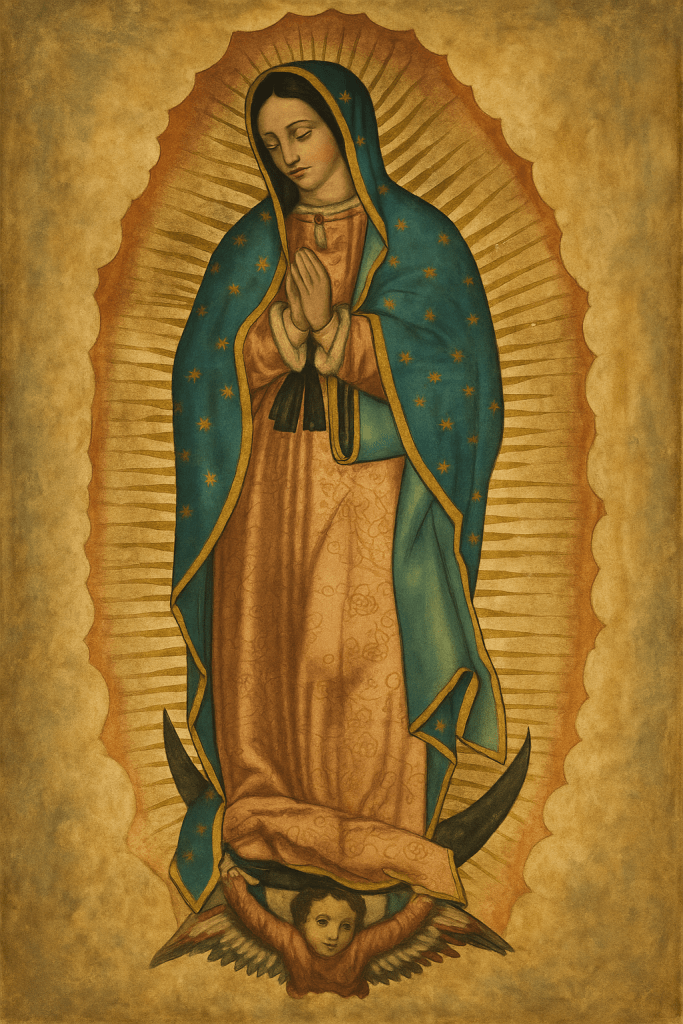
One reason Guadalupe remains so beloved is that her image communicates across language and culture. Even without the backstory, many people sense reverence in her quiet presence: her eyes are lowered, her face is gentle, and her hands are folded in prayer, conveying humility and intercession rather than display. Behind her, the broad sunburst of rays reads as radiance and protection, while the crescent moon beneath her feet—cradled by an angel—adds to the sense of heaven drawing near to earth.
Devotion has long lingered over the image’s details: the star-strewn mantle and the dark ribbon at her waist, often understood as a sign of pregnancy. Taken together, these symbols have been read as a soft proclamation that God comes close, Christ is being brought into the world, and no one is too small to be seen.
“Am I Not Here, I Who Am Your Mother?”
The reassurance associated with Guadalupe—“Am I not here, I who am your mother?”—is not a promise that suffering will never happen. It is a promise that suffering will not be faced alone. Guadalupe’s tenderness is part of her power. She does not arrive with spectacle or threats. She arrives with steadiness—the kind that calms the anxious heart and reminds the weary soul that dignity is not earned by status, wealth, or eloquence. Dignity is a gift, because love is a gift.
Why Guadalupe Still Matters Today
In a world that often feels fragmented, Guadalupe continues to gather people because her story is about bridges—between cultures, languages, and wounds. She resonates deeply with those who feel unseen, especially the poor and displaced, the immigrant and the outsider, the tired parent and the overburdened student, and the believer rebuilding faith after disappointment.
Her devotion is also communal. It lives in songs, vigils, early-morning walks to church, processions, and shared meals. Families pass her story down the way they pass down recipes and prayers—something sacred that survives time because it meets a real human need: the need to be held, guided, and reminded that heaven can feel close.
Living the Message of Guadalupe
Honoring Our Lady of Guadalupe does not require grand gestures. It can begin in small ways: a simple prayer, a candle lit in gratitude, a quiet return to her story when the world feels harsh. Many people honor her best by living what she represents—choosing compassion, offering dignity, and showing up for others with patience and tenderness.
In the end, Our Lady of Guadalupe is not only a memory from the past. She is a living reminder that God draws near, especially to the humble and the hurting. If your heart is tired today, her message remains steady and simple: you are not alone, you are not forgotten, and you are loved.
 Moments & Musings
Leave a comment