P. E. Nyavor
There are days when the word family feels like a warm blanket—safe, familiar, full of laughter and food and people who know your story.
And there are days when family feels like a complicated room you don’t know how to enter without hurting something. A room full of old misunderstandings, sharp silences, unmet expectations, and prayers you’ve prayed so often they’ve started to sound like echoes.
So when the Church gives us the Feast of the Holy Family, it’s tempting to think it’s only for the warm-blanket kind of families.
But I don’t think that’s the point.
I think this feast is for all of us who are trying to love people closely—and learning how hard and holy that can be.
God chose a home
It’s easy to imagine God arriving with fireworks and certainty.
Instead, He arrives as a baby—small enough to be carried, vulnerable enough to need care.
And He arrives inside a family.
Not as an idea. Not as a distant miracle.
But as a child who needed to be fed. Changed. Comforted. Protected.
God could have chosen any route into the world. He chose a home.
Which means home life—ordinary life—matters more than we think.
The hidden years
Most of Jesus’ life was not public.
No crowds. No spotlight. No recorded sermons.
Just Nazareth.
Just the rhythms: waking up, eating, working, walking, returning, resting.
Just the quiet building of a heart.
Sometimes I think we chase “big” moments with God because they feel easier to measure. But the Feast of the Holy Family gently insists that formation happens in the small.
In the way you respond when you’re tired.
In the way you speak when you’re misunderstood.
In the way you keep showing up when you’d rather withdraw.
Holiness is often not dramatic.
Holiness often looks like staying.
Mary: the bravery of “yes”
Mary’s yes wasn’t neat. It wasn’t convenient. It wasn’t safe.
Her yes carried questions. Her yes carried risk.
Her yes carried the weight of being misunderstood—maybe even by the people closest to her.
Mary teaches me something tender: you can say yes to God while still having unanswered questions. You can carry faith and fear in the same hands.
Her holiness wasn’t perfection.
Her holiness was presence.
Joseph: the quiet strength we don’t praise enough
Joseph doesn’t say much in Scripture—maybe because his love was mostly action.
He stays. He protects. He listens. He carries responsibility without applause.
He does what love often requires: the unglamorous work of holding things together.
Joseph reminds me that some of the strongest people are the ones who are quietly faithful.
The ones who make sure the child gets home safe.
The ones who provide when it’s hard.
The ones who keep peace in a storm without needing to be noticed.
The Holy Family wasn’t spared difficulty
If you really look at the story, the Holy Family is not a polished picture frame.
They face uncertainty.
They face danger.
They flee as migrants.
They live with the ache of not having control.
And yet—God is there.
That’s what makes this feast so comforting to me: it does not teach that holiness means a pain-free life. It teaches that God can be found in the middle of real life.
In the middle of your life.
What if holiness is learning to love well at close range?
Family love is different from public love. Public love is easy to perform.
Family love is private. It sees your mood. It sees your flaws. It sees what you become when you’re stressed.
Family asks you to love people when you don’t feel your best.
To forgive when you feel justified.
To speak gently when you want to be sharp.
To choose peace when you want to win.
This is why family can shape us so deeply—because it is the place where love is tested not in theory, but in practice.
And maybe that’s why God chose it.
A reflection for today
On this feast, I find myself asking:
- Where in my home life have I been trying to be “right,” instead of trying to be loving?
- Who have I been avoiding because it feels easier than making peace?
- What part of my family story do I need to place gently into God’s hands again?
- What would it look like if I stopped waiting for the “perfect moment” to love better—and started now?
Sometimes the most spiritual thing we can do is not another big promise, but one small act:
A sincere apology.
A thoughtful message.
A softer tone.
A moment of prayer before reacting.
A decision to listen instead of defend.
A simple prayer for imperfect homes
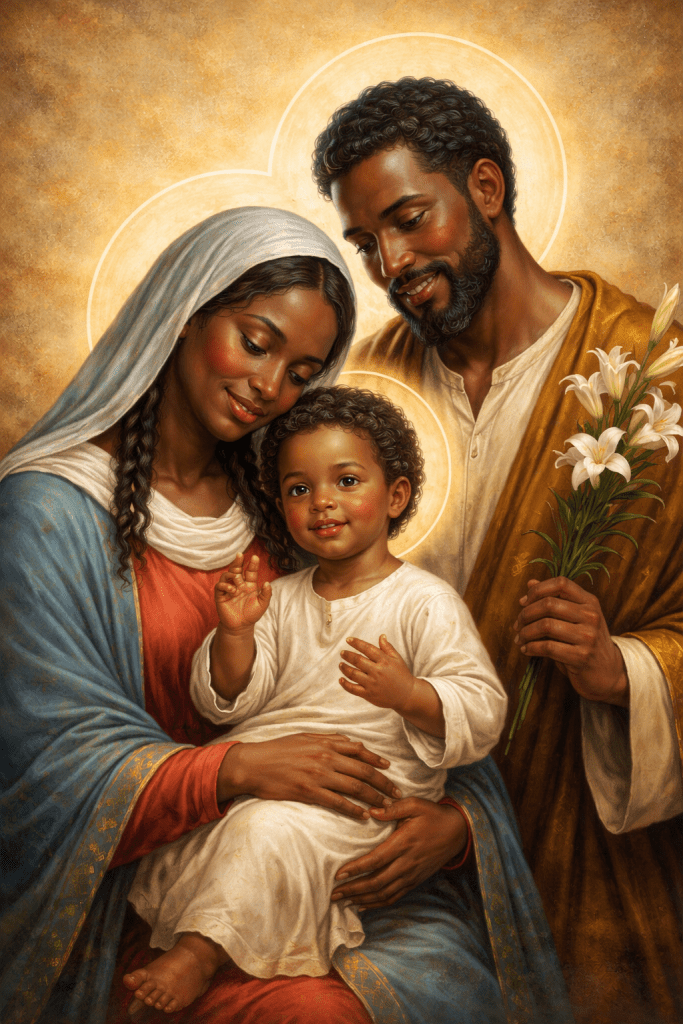
Jesus, Mary, and Joseph—
teach me how to love the people in front of me.
Not the ideal version of them, not the version I wish they were,
but the real people—imperfect, tired, trying.
Heal what has become heavy in our home.
Strengthen what is fragile.
Give us peace that is practical,
forgiveness that is real,
and love that returns—even after hard days.
Make my home a place where You are welcome.
Amen.
Merry Christmas to you and yours!
 Moments & Musings
Leave a comment